


"History begins at Sumer."
- Samuel Noah Kramer,
History Begins at Sumer (1956)
BENEFITS
◆ Understand the origins of civilization
◆ Better understand the Bible and its historical context
◆ Discover the first great cultures of humanity
◆ Develop a broader historical and geopolitical perspective
◆ Access knowledge grounded in archaeology and ancient sources
INTRODUCTION
The Middle East was the cradle of some of the earliest civilizations in human history. It was in this region that the first cities, writing systems, legal codes, and great empires emerged - profoundly transforming the development of humanity.
In this course, we explore the rise of civilizations in Mesopotamia, Egypt, the Levant, and ancient Persia, analyzing how these peoples developed political institutions, religious traditions, and forms of social organization that left a lasting legacy for the world.
Throughout the lessons, students are invited to understand how these societies formed, how they functioned, and why they remain fundamental to understanding global history.
WHAT WILL YOU LEARN?
-
How the first cities in history emerged
-
The Sumerian civilization and the birth of writing
-
The great empires of Mesopotamia
-
The formation of Egyptian civilization
-
The peoples of the Levant and their trade networks
-
Ancient Israel in the context of the Near East
-
The Persian Empire and its political organization
-
The legacy of the ancient civilizations
COURSE STRUCTURE
MODULE 1: INTRODUCTION TO THE ANCIENT NEAR EAST
-
What is the Ancient Near East
-
Historical geography: the Fertile Crescent
-
Archaeology and historical sources
-
Writing, sources, and the interpretation of ancient history
MODULE 2: THE URBAN REVOLUTION
-
From village to city
-
Uruk and the birth of urban civilization
-
Agriculture, irrigation, and social organization
-
The emergence of cuneiform writing
MODULE 3: THE SUMERIANS AND THE FIRST CITY-STATES
-
Political structure of the city-states
-
Religion and temples in Sumerian society
-
Economy, trade, and administration
-
Literature and mythology (Gilgamesh and ancient traditions)
MODULE 4: THE FORMATION OF THE FIRST EMPIRES
-
The Akkadian Empire
-
Babylon and the legal tradition
-
Assyria and imperial military power
-
Imperial politics and administration
MODULE 5: EGYPT IN THE CONTEXT OF THE ANCIENT NEAR EAST
-
The Nile and the formation of the Egyptian state
-
The pharaoh and the ideology of power
-
Religion, temples, and cosmology
-
Monuments, pyramids, and sacred architecture
MODULE 6: THE LEVANT AND THE MEDITERRANEAN NETWORKS
-
Canaan and the peoples of the Levant
-
Cities and trade routes
-
The Phoenicians and maritime expansion
-
Culture and exchange between civilizations
MODULE 7: ANCIENT ISRAEL IN THE CONTEXT OF THE NEAR EAST
-
Israel and Judah in the regional landscape
-
Israelite religion and biblical traditions
-
Prophets, monarchy, and religious identity
-
Israel under regional empires
MODULE 8: THE PERSIAN EMPIRE AND THE IMPERIAL ORDER
-
Cyrus and the rise of Persia
-
Administrative structure of the empire
-
Religion and imperial ideology
-
The Persian world and its connections
MODULE 9: RELIGION AND WORLDVIEW IN THE ANCIENT NEAR EAST
-
Mythologies of Mesopotamia
-
Egyptian religion and the afterlife
-
Cults, temples, and priesthood
-
Religion and political legitimacy
MODULE 10: THE LEGACY OF THE ANCIENT NEAR EAST
-
The invention of writing and bureaucracy
-
Laws, states, and empires
-
Religions and cultural traditions
-
The impact of ancient civilizations on world history
COURSE FORMAT
The course was structured to facilitate the understanding of complex historical topics through different learning resources:
-
In-depth articles organized by lesson
-
Historical maps
-
Images of archaeological sites
-
Quotes from leading historians
-
Book recommendations for further study
MAP 1: THE FERTILE CRESCENT AND THE URBAN REVOLUTION
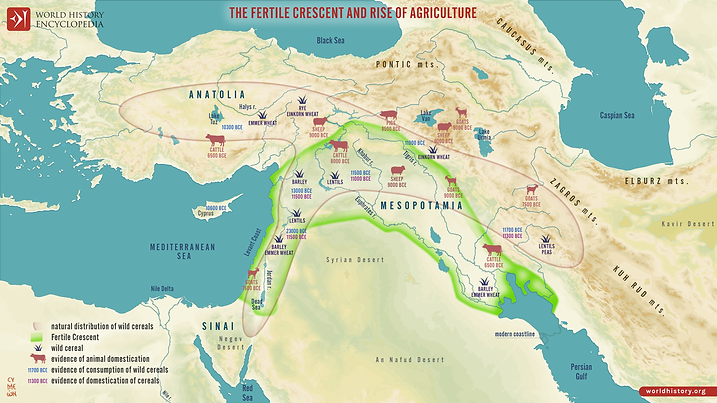
Map: Fertile Crescent and Urban Revolution. Source: World History Encyclopedia
Why did civilization emerge exactly here? Observe the green arc connecting Egypt to Mesopotamia. This region, known as the Fertile Crescent, was the only biological refuge capable of sustaining the transition from nomadic to sedentary life.
The Foundation of Civilization: The map reveals the natural distribution of cereals and the domestication of animals that enabled the first agricultural surpluses to emerge. Without these resources, there would be no cities, no writing, no laws that shaped the world.
Course Insight: In this module, you will understand that the first complex societies did not arise by chance, but as a direct response to geographic abundance and the need to organize labor and large-scale irrigation.
MAP 2: THE SUMERIAN URBAN EXPLOSION

Map: Sumerian Civilization. Source: World History Encyclopedia
Where the modern world began. This map details the network of Sumerian city-states (such as Ur, Uruk, and Eridu) that flourished between the Tigris and Euphrates rivers. It was in this setting that humanity made its greatest intellectual leaps.
The Cradle of Inventions: Note the density of red dots in southern Mesopotamia. In these cities, the need to manage water resources led to the creation of cuneiform writing, a legal system, and complex public administration.
Course Insight: You will see how these cities were not merely clusters of people, but true engines of innovation. By understanding Sumer, you understand the foundation of all social organization that followed - from politics to the first forms of institutionalized religion.
WHO IS THIS COURSE FOR?
-
Those interested in ancient history
-
Students of History, International Relations, and Theology
-
Bible readers interested in the historical context of the Middle East
-
Anyone interested in the origins of civilization
ABOUT THE COURSE CREATOR
The Oriente History courses were developed from years of dedicated study of the history and geopolitics of the Middle East.
The creator (Vanessa Chamma) combines historical research, specialized reading, and personal experience with the region. Her background includes direct experience of the Middle East context during the 2006 war in Lebanon - an experience that awakened an even deeper interest in the history, conflicts, and transformations of the region.
This combination of historical study and personal experience contributes to an approach that seeks to present topics clearly, contextually, and with solid foundations.
HISTORIANS AND WORKS CONSULTED
The course draws on the scholarship of leading specialists in the study of ancient Near Eastern civilizations, including:
-
Marc Van De Mieroop
-
Amélie Kuhrt
-
Mario Liverani
-
Karen Radner
-
Paul Kriwaczek
ADMISSION AND INTEREST FORM
Please fill in all fields carefully. This information will be used for class leveling and official communication.
Understanding the ancient civilizations of the Middle East is understanding the origins of writing, cities, laws, and many of the cultural traditions that shaped the history of the world.
REFUND POLICY
We believe in the depth of this content. However, if within 7 days you feel the course is not what you expected, we will refund your investment in full, no questions asked. Our commitment is to your intellectual satisfaction.
QUESTIONS?
If you still have questions about the content or access, contact our support team: contato@orientehistory.com
FAQ
IS THE COURSE ALREADY AVAILABLE FOR IMMEDIATE ACCESS?
The Ancient Civilizations course is in its final stage of academic curation and production. We chose not to release rushed content - we are refining each lesson and selecting bibliographic materials to ensure a deep and rigorous experience. By filling out the Admission Form, you secure your priority on the waiting list and will receive progress updates directly on our Telegram channel.
WHAT MAKES THIS COURSE DIFFERENT?
The course presents the ancient civilizations of the Middle East within a broad historical context, combining clear explanations with images, maps, visual reconstructions, and references from historians that help better understand the ancient world.
WHICH CIVILIZATIONS WILL BE COVERED?
The course explores several fundamental civilizations of the ancient world, including Mesopotamia, Egypt, Assyria, Babylon, Persia, and the ancient cultures of the Levant, as well as the historical context in which these societies developed.
HOW ARE THE LESSONS ORGANIZED?
The lessons are organized as structured articles, accompanied by historical images, maps, visual reconstructions, and links to maps on the Oriente History blog to help contextualize each topic.
IS THE COURSE TOO TECHNICAL OR DIFFICULT TO FOLLOW?
No. The content was designed to be clear and accessible, while presenting important historical information grounded in academic research.
DOES THE COURSE ADDRESS ARCHAEOLOGICAL DISCOVERIES?
Yes. Whenever possible, the course uses archaeological references, historical reconstructions, and important discoveries that help better understand how the ancient civilizations lived.
DOES THE COURSE USE RELIABLE HISTORICAL RESEARCH?
Yes. The content was developed based on historical studies and research by specialists on the Ancient Near East, seeking to present information clearly and with solid foundations.
DOES THE COURSE HAVE A RELIGIOUS FOCUS?
No. The goal of the course is to present a historical approach to the ancient civilizations of the Middle East, exploring their political, cultural, social, and religious aspects within a historical context.
HOW LONG DOES IT TAKE TO COMPLETE THE COURSE?
The course is organized so that each lesson can be studied at your own pace. You can advance gradually according to your availability.
WHAT WILL I HAVE LEARNED BY THE END OF THE COURSE?
By the end of the course, you will have a much clearer understanding of the emergence of the first cities, the development of the great empires of the ancient world, and the importance of these civilizations for the formation of human history.
WHY STUDY THE ANCIENT CIVILIZATIONS?
Because understanding these societies is understanding the roots of the modern world. Many institutions, ideas, and structures that are still part of our society began to emerge in these first civilizations.
Your safety and transparency are our priority.
EXPLORE ALSO

Throughout history, few texts have sparked as much fascination, debate, and interpretation as biblical prophecies. Written during periods marked by wars, political crises, exiles, and profound transformations in the ancient Middle East, these words have crossed millennia and continue to be read, discussed, and interpreted to this day. Prophets spoke in times of powerful empires, warned kings, announced judgments and hope, and recorded messages born in very specific historical contexts.
But to truly understand these prophecies, one must go beyond an isolated reading of the texts. It is necessary to know the world in which they arose — the landscape of ancient civilizations, the conflicts between empires, the political crises of Israel and Judah, and the transformations that marked the Middle East throughout history.
In this course, you will be invited to explore biblical prophecies within their historical, cultural, and political context, seeking to understand not only what the texts say, but also the environment in which they were written. Because understanding biblical prophecies begins with a fundamental question: What kind of world did the prophets speak into?
FORMAT:
10 MODULES
LESSONS:
ARTICLES
MAPS:
ON THE BLOG
The Middle East has occupied a central place in the world's political history for centuries. It was in this region that some of humanity's oldest civilizations arose, great religious traditions were born, and powerful empires vied for strategic territories over millennia.
But the Middle East is not only important for its history. Today, the region continues to be one of the main centers of tension and interest in international politics. Armed conflicts, rivalries between states, territorial disputes, energy resources, and strategic alliances make the Middle East one of the most complex scenarios in contemporary geopolitics. To understand these events, it is necessary to go beyond the news and analyze the historical, political, and strategic processes that have shaped the region over time.
In this course on the Geopolitics of the Middle East, you will be invited to explore the main factors that influence the political dynamics of the region. Throughout the classes, we will analyze the historical origins of many current conflicts, the rivalries between regional powers, the role of major international powers, and the strategic interests that have transformed the Middle East into one of the most contested spaces on the planet.